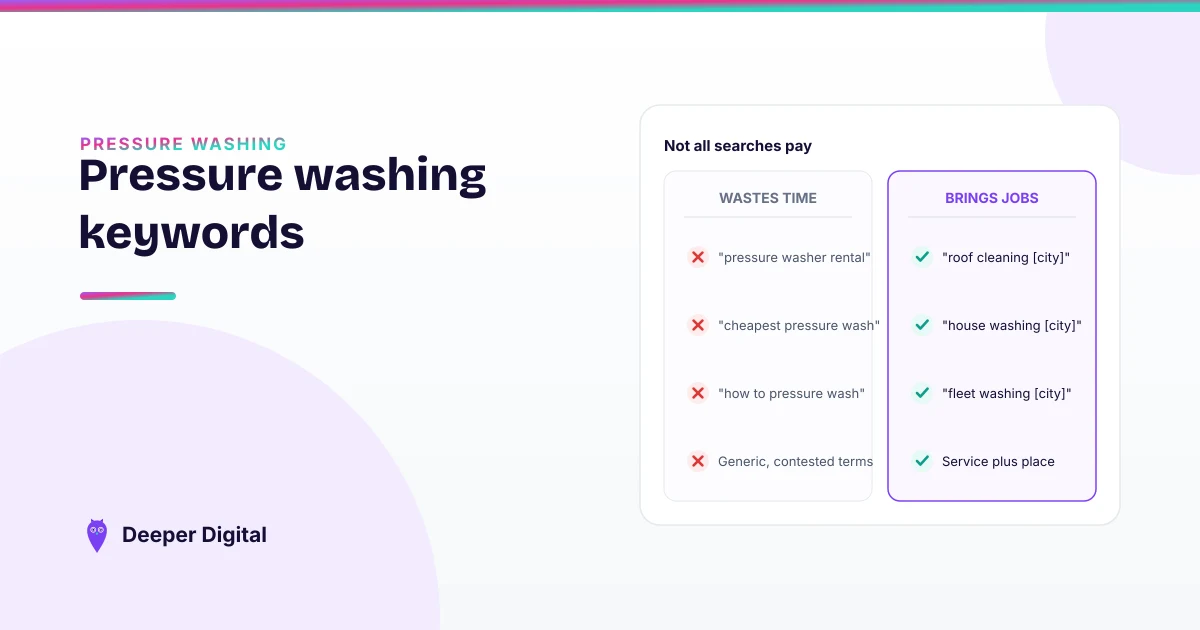
The pressure washing searches that bring paying jobs are service-plus-place terms — “house washing [city],” “roof cleaning near me” — not the generic “pressure washing.” Most companies chase the generic term anyway: it’s the most contested phrase in the trade, it tells you nothing about what the person wants, and half the people typing it are looking for a rental.
The searches that actually produce paying work are more specific, less contested, and mostly ignored.
Which searches bring paying jobs?
Service plus place, where the person has already decided what needs doing:
- “house washing [city]”
- “driveway cleaning near me”
- “roof cleaning [city]”
- “gutter cleaning near me”
- “concrete cleaning [city]”
- “commercial pressure washing [city]”
- “fleet washing [city]”
Somebody typing “roof cleaning [city]” has a dirty roof and a budget. Somebody typing “pressure washing” might be comparison shopping, might be trying to rent a machine, might be nothing at all. The specific term is a shorter walk from search to booked job. (The full pressure washing playbook.)
Which searches waste your time?
Three categories worth knowing:
Rental intent. “Pressure washer rental,” “rent a power washer.” Different business entirely.
Price-only intent. “Cheapest pressure washing,” “pressure washing prices per square foot.” These convert badly and the jobs that come out of them are the ones you regret.
DIY intent. “How to pressure wash a driveway.” That person is not hiring you. It’s fine as content, but it’s not a job.
You don’t need to actively avoid these; you just shouldn’t build your strategy on them.
How do you find the terms for your own market?
Three free sources beat most paid tools for a single service area:
Google autocomplete, on your phone, in your service area. Type “pressure washing” and watch what Google suggests. Those suggestions are real searches from near you.
“People also ask” and related searches at the bottom of the results page.
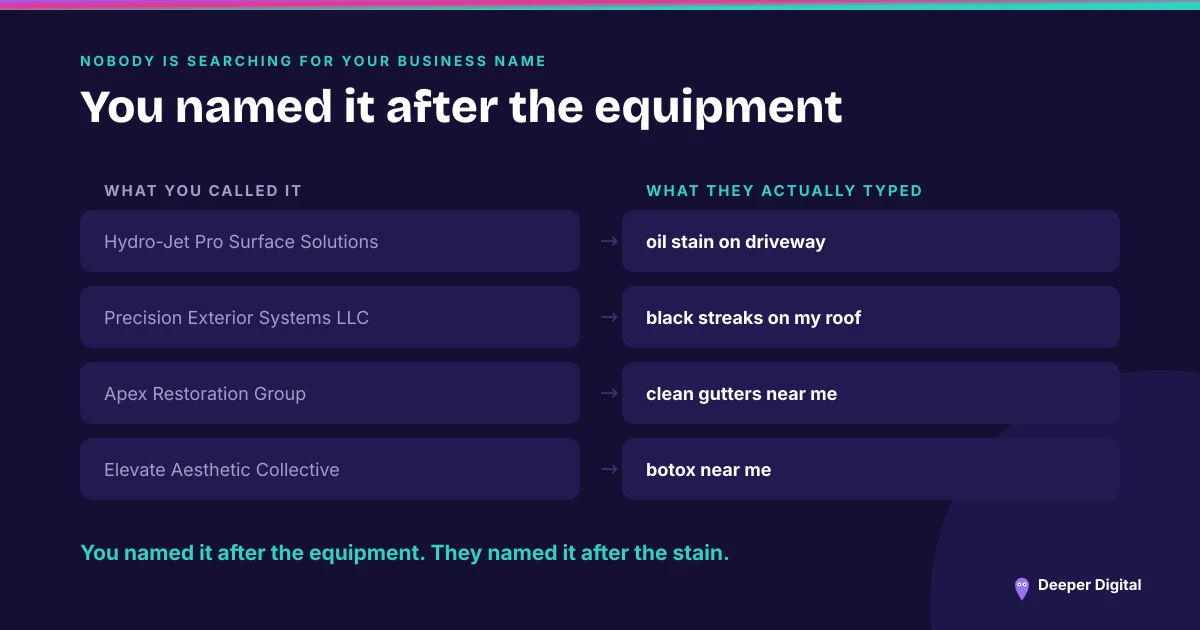
Your own phone. Write down what customers actually say for a month. People book using ordinary words — “green stuff on my siding,” “black streaks on my roof” — and those phrases are searches too.
Where do the keywords actually go?
Not stuffed into a paragraph. Into structure:
- Services on your Google Business Profile — every service named separately: house washing, roof cleaning, driveway, gutters, concrete, fleet, commercial.
- A page per service on your site, where the work justifies it.
- A page per town you genuinely serve — real pages, never thin clones.
Google’s category and services guidance covers the profile side.
What about the commercial searches?
They’re the underserved half of the trade. “Commercial pressure washing [city],” “fleet washing [city],” “parking garage cleaning” have far less competition than residential and produce recurring contracts rather than one-off jobs. (How to actually win those contracts.)
Most companies never list a commercial service at all, which is why the search sits open.
Do keywords still matter with AI answers?
They matter differently. ChatGPT and Gemini answer “who does roof cleaning in [city]” by reading profiles and pages. The contractor whose services are spelled out is the one that can get named back; a profile that says “cleaning services” gives an assistant nothing to quote. (How AI assistants choose.)
Pressure washing keyword checklist
- Every service named separately on the profile
- Service-plus-place terms prioritized over the generic one
- Commercial and fleet terms listed, not just residential
- Customer phrasing captured from real calls
- A real page per service and per town you serve
- Rental and DIY intent recognized and deprioritized
The honest shortcut
Keeping the profile services and weekly posts pointed at these terms is the half that slips when you’re on a truck all day.
That upkeep is what we run — done-for-you pressure washing SEO; pages on your own site are quoted separately. Want your market’s term list first? Free game plan.
 NASP
NASP  Wild Foods Co.
  Noble Origins
  Cowboy Pools
  BT Biltong