Home care SEO for independent agencies
When a family searches “in-home care near me,” they call one of the first names on the map. Usually an adult child, in a hurry, never page two. Home care SEO is the work that puts your agency on that shortlist — the Google Business Profile, the categories and services, the review flow, the towns you cover, and the directory listings that families read — and that ChatGPT and Gemini read too. We run all of it for you, from $599/mo.
What does home care SEO actually include?
Six things, run every month: a profile built for how families search, a review engine, weekly posts, Q&A and photos kept current, your website built and hosted, and one report in plain English. Every item is a deliverable you can check on your own profile — we guarantee the work, never a ranking.
Profile built for how families search
Primary category set correctly (Home health care service or the right fit), every service listed — companion care, personal care, respite, dementia support, post-surgery help — plus the towns and neighborhoods you cover, so you show up for the exact searches families type.
Review engine that builds trust
Families choose care on trust, and nothing earns it like other families' words. We give you a gentle, respectful ask that turns grateful clients into Google reviews naming the care and the town — a signal that lifts rank and reassures the next family.
Weekly posts that reassure
One post a week — a care tip, a caregiver spotlight, availability updates — keeps your profile active and shows families a real, caring team behind it. Written and scheduled for you.
Q&A & photos kept fresh
We seed the questions families actually ask, answer them, and keep your photos current — signals Google rewards that also reassure the next family into a call.
Local citations matched (quoted on top)
Agency name, phone, and service area identical across the 25 directories Google cross-checks, including the senior-care and home-health listings families browse first. A mismatch quietly holds a good profile back. Built on every plan — bought once and owned, never rented.
Plain-English reporting
One monthly report: calls, messages, map-rank movement, new reviews, and exactly what shipped. No vanity metrics.
Families decide on trust, and trust starts on the map
It's 10pm and a daughter two states away is choosing who'll be in her mother's house by Friday. She searches, she reads reviews, and she calls one of the first names she trusts. Many independent caregivers have a thin or missing Google profile, so the map pack is where the decision happens — not on a lead site that resells the same family to four competitors.
Every deliverable is on the card, and a month we don’t ship it is free. You can check each one on your own profile.
Owning your leads vs renting them
A home care lead from Google Ads or LSA typically runs $80–200 — and aggregator sites sell that same family to three of your competitors — every lead, forever. Miss a month of budget and the phone goes quiet the same day. Next year, the same lead costs more.
One flat fee builds an asset: profile, reviews, pages that keep ranking. The same profile produces more in month 12 than month 2 — without costing more — so your cost per lead falls while everyone renting pays full price.
Worked example: At $100 a shared lead, 8 inquiries is $800 a month, rented. $599 flat gets calls from your own profile, not a shared list. One care client is often worth thousands per month for a year or more — the highest lead value of any local trade.
Prefer to DIY?
We publish the whole playbook for free:
What ChatGPT says when families ask
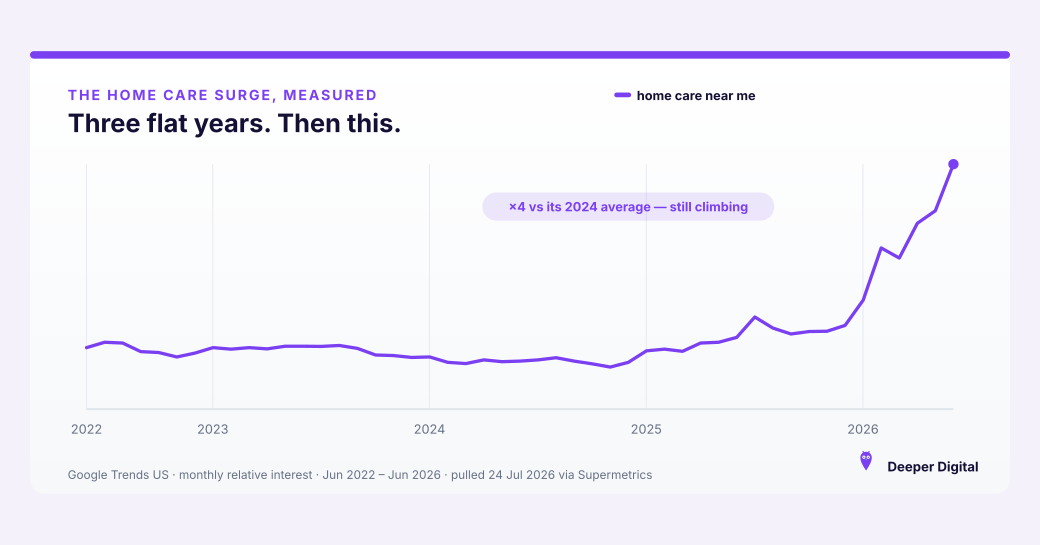
Ask ChatGPT or Gemini for a trusted caregiver in your town and it answers from your Google Business Profile and your reviews. Families are asking that way more and more, and it's the same material we work on every month. Here's how ChatGPT and Gemini pick which businesses to name.
One search. Two different answers. The family reads the top one first.
We searched "home care for elderly parents killeen tx". Google put an AI summary above everything else and named four providers. Below it, the map pack listed three agencies — and two of the four names in the AI answer were not in the map pack at all.
So there are now two shortlists on one screen, built from different signals, and a family under pressure reads the top one first. Being in the map pack is no longer the whole job. Both answers are assembled from your profile, your reviews and your listings — which is the work, and it is the same work either way.
The three agencies in that pack held 48, 9 and 8 reviews between them. Packs like that are winnable, and they do not stay that way.
Read off the Google results page, not Maps. This moves — have us run your exact search rather than trusting a number from August.
What families check
Whether anyone replied to the reviews. Whether the photos are of your actual caregivers. Whether the hours are right. Whether the profile has been touched this year. Each one is small, and together they are the decision.
Home care SEO vs home health care SEO: which one are you?
They are different services and families type both. Home health care is skilled, clinical care ordered through a doctor — nursing visits, wound care, therapy. Home care is non-medical help at home: companionship, bathing and dressing, meals, transport, respite. Google treats them as different categories, so an agency that does one and is filed as the other gets shown to the wrong families. We check that first. Here is the full split, and how a profile should handle it honestly.
The Google Business Profile settings that decide home care rank
Most of the movement we see on a home care profile comes from four settings, not from anything clever. Primary category — Home health care service, Home care service or Aged care, whichever is honestly right. Services — companion care, personal care, respite, dementia support, post-surgery help, each one listed rather than left blank. Service area — the towns you will actually drive to, not the whole state. Hours — because a family calling at 9pm reads “closed” as “not available.” The home care profile walkthrough covers each one, and how service areas really work is the setting most agencies get wrong.
Do home care agencies need a page per town?
Only where you genuinely operate, and only if the page says something a family in that town could not get from the homepage. A page that swaps the city name into the same paragraph is the pattern Google now demotes as scaled, unhelpful content, and it is the reason a lot of agency sites quietly stopped ranking. Where service-area pages earn their place is our read on it, and if you bill across two counties, the NAP problem that creates is worth ten minutes before you build anything.
Related care types we work on
Senior care is a family of searches, and the profile work is close to identical across them — only the words families type change. Hospice SEO · memory care SEO · skilled nursing SEO · nursing home SEO · senior living SEO. If you are hiring as hard as you are selling, caregiver recruitment marketing uses the same profile, pointed at applicants instead of families. Prefer to run it yourself? The buyer’s checklist for home care SEO services names the deliverables any proposal should carry, ours included.
Common questions
How do families actually choose a caregiver online?
Usually an adult child searching from another city, under pressure, comparing three names on a map. They read reviews, look for real photos and a complete profile, and rule out anything that looks abandoned. The profile is doing the reassuring before anyone picks up the phone.
Can you help us get found when families ask ChatGPT for care options?
The assistants pull from the same public signals as the map: a complete profile, reviews with real text, consistent listings and pages that answer real questions. We run the profile, review and listing side of that — the material an assistant reads when it builds its short list.
Do you write anything that could be mistaken for medical advice?
No. Everything we publish stays on services, coverage areas, availability and what working with you looks like. We do not make clinical claims on your behalf, and anything that reads like one gets cut before it ships.
How long does home care SEO take to show anything?
Profile corrections — category, services, service area, hours — can change what Google shows within days. Reviews and citations move slowly and compound over months. We guarantee the deliverables and the reporting, never a ranking or a timeline, because nobody can honestly guarantee either.
Is home care SEO different from home health care SEO?
The work is the same; the words and the category are not. Home health care is skilled clinical care ordered through a doctor. Home care is non-medical help at home. Google files them under different categories, so an agency listed as the wrong one gets shown to families looking for a different service.
What do you need from us to start?
Manager access to your Google Business Profile, photos we are cleared to use and quick approvals on drafts. Under an hour in the first month.
See how families find caregivers in your area — free
We'll run your towns' searches, show you which agencies rank today, and map what we'd do first. No cost, no card.
Get my free game plan →