Review gating is a review request that screens for sentiment first: a quick survey asks how things went, happy customers get the Google link, unhappy customers get a private form. Google’s Maps policies prohibit rating manipulation, defined to include any attempt to directly or indirectly influence a place’s star rating, and pressuring customers for specific ratings is named as an example. The pattern also leaves a mark on your own numbers.
The pattern
It arrives inside software, which is why so many owners run it without ever deciding to. The tool offers a “smart” review flow, the flow includes a sentiment question, and the sentiment question exists to sort people. Nobody at the business writes down “route the unhappy ones away.” It is a default.
Sold as reputation management, which is accurate in roughly the way a locked suggestion box is feedback.
Google’s wording
Google’s rating manipulation policy, read 24 August 2026, covers “any attempt to directly or indirectly influence the star rating” of a place through fake and misleading content, and lists coercing or pressuring customers for specific ratings or reviews among its examples.
Two things follow from how that is written. First, the word gating never appears — the policy describes an effect, so a new tool with a new name is not a new question. Second, “indirectly” is the operative word, and a survey that decides who gets the link is an indirect method by construction.
The report button most owners have never seen
Google publishes a path for this in the Maps app: find the business, tap Suggest an edit, then Report business conduct. Google names review incentives and pressuring people into reviews as the behavior that path exists for.
Anyone can use it. A customer who got routed to the private form, a former employee, the competitor two seats above you in the pack. Google publishes the form and no timeline to go with it, so the honest expectation is that filing is easy and the outcome is unknown.
The federal layer
The FTC’s Rule on the Use of Consumer Reviews and Testimonials — 16 CFR Part 465, finalized in 2024 — sits underneath the platform policy. Its section on buying positive or negative reviews prohibits incentives conditioned on a review expressing a particular sentiment, and the FTC’s guidance says that section applies whether the reviews land on your own site or on a third-party platform. A separate section addresses suppressing reviews, and covers things like intimidation or false accusations used to get a review taken down.
Routing a survey is not the same conduct as threatening a reviewer, and which section touches which flow depends on how the flow is built. I am not a lawyer and this is not legal advice. What is worth noticing is the direction of travel: the rules have moved one way for years, and none of the movement has been toward more filtering.
The tell in your own numbers
Gating is visible from outside, and this is the part vendors do not mention.
A rating that has not moved in two years. A review body with no three-star entries in it at all — not few, none. A volume that spikes on the days the automation runs and flatlines between them. Ordinary businesses collect ordinary distributions; a perfectly clean one is evidence of a filter, not evidence of perfection.
The other tell is closer to home: you stop hearing about problems. The private form absorbs them, nobody reads it, and the complaint that would have told you a technician is rushing jobs never reaches anybody who could act on it.
The alternative, which is duller
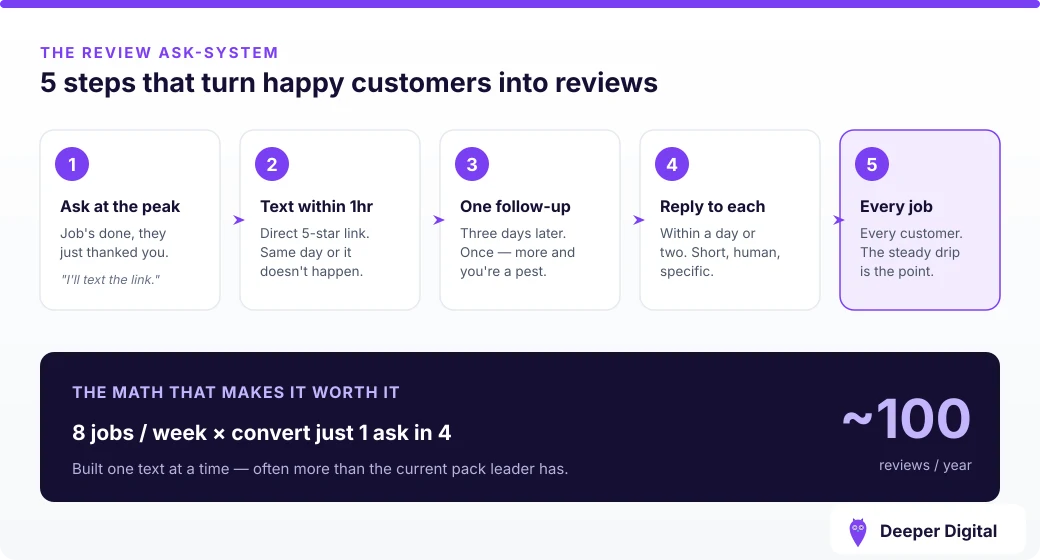
Ask everyone. Same message, same moment in the job, same destination. Then reply in public to what comes back, poor reviews included — a calm, specific reply on a two-star review does more for the reader than the two-star review does against you. (Reply templates by situation.) And keep the asking constant rather than seasonal, because recent reviews carry the reading. (Why velocity beats total count.)
There is no compliant version of the sorting step. Do not look for a softer one — the pattern is what gets recognized, not the wording.
Asking every customer and answering what comes back is ongoing work, not a project. What that covers month to month, and how to build the ask itself.
 NASP
NASP  Wild Foods Co.
  Noble Origins
  Cowboy Pools
  BT Biltong