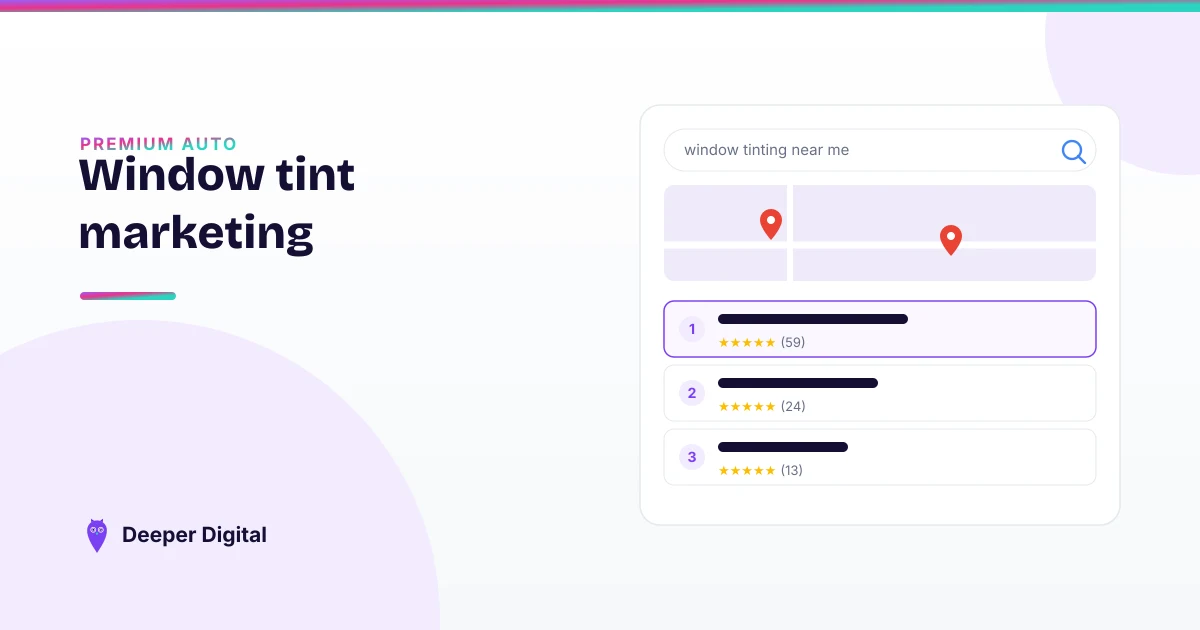
Window tint is bought faster than almost anything else in the auto trade. Somebody gets a new car, decides on Saturday morning that they want it tinted, searches, and books that afternoon.
There’s no research phase to influence and no referral chain to cultivate. Whoever is in the map pack at the moment they search gets the call.
What do window tint customers actually type?
- “window tinting near me”
- “car window tint [city]”
- “ceramic tint near me”
- “tint shop near me”
- “windshield tint [city]”
- “tint legal limit [state]”
That last one is interesting — it’s an informational search from someone about to buy, and almost no shop answers it, because it doesn’t look like a lead. A page explaining your state’s legal limits plainly catches that person mid-decision. (Why question-shaped pages get surfaced.)
Why does the profile decide this trade?
Because the buying window is hours, not weeks. There’s no time for a website to work on someone, no time for a nurture sequence. The Google Business Profile is the entire storefront.
Which means the unglamorous things are decisive: accurate hours including Saturday, real photographs of finished cars, current reviews, and services named specifically. A shop with forty reviews and correct hours beats a better shop that left its profile half-built. (The wider detailing playbook.)
Should ceramic be listed separately?
Yes, and it’s the highest-value thing on this page. Ceramic is the premium product and anyone who’s done ten minutes of research searches it by name. If your services list says only “window tinting,” you don’t match “ceramic tint near me.”
List them all as separate named services: ceramic tint, carbon tint, standard tint, windshield strips, tint removal. Tint removal in particular is a real search from people unhappy with someone else’s work, and almost nobody lists it.
What about residential and commercial?
Different buyer, different search, and worth naming explicitly if you do it. A homeowner searching “home window tinting [city]” or “office window film near me” is comparing energy savings and glare reduction, not looks — and an automotive-only listing won’t surface for them at all.
If you do both, say both. It’s a second market with far less competition than the car side.
How much do reviews matter?
A lot, and recency matters more than total. Tint is a visible, subjective result — buyers want to see that other people’s cars came out clean, with no bubbles and no gaps at the edges.
Reviews that mention the specific vehicle and product do more work than generic five-stars. Ask after the customer picks the car up, when they’re looking at it. (The system for that.)
What about warranties?
State it plainly on the profile and the site. Lifetime warranty on ceramic, whatever your terms actually are. It’s a genuine differentiator against the cheapest shop in town, and it’s the thing the buyer is quietly worried about — bubbling and purpling in two years.
The mechanics of setting all that up sit in Google’s own category rules.
Window tint marketing checklist
- Ceramic, carbon, standard and removal listed as separate services
- Residential and commercial named if you do them
- Hours accurate, especially Saturday
- Real photographs of finished vehicles
- Recent reviews naming vehicle and product, all replied to
- Warranty terms stated plainly
- A page answering your state’s legal tint limits
The honest shortcut
The setup is a weekend; the upkeep is the part that slips when the bay is full.
We take that part — see done-for-you local SEO for auto detailing. Or grab a free game plan: who a Saturday-morning tint search turns up, and how long ago each last posted.
 NASP
NASP  Wild Foods Co.
  Noble Origins
  Cowboy Pools
  BT Biltong