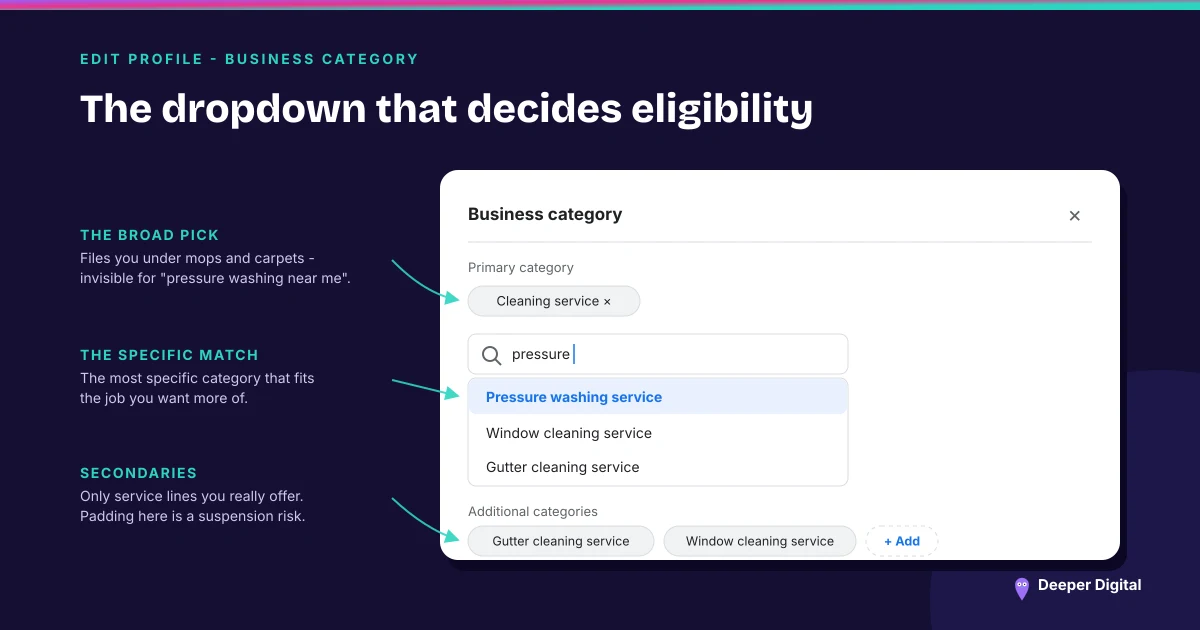
Open the category picker, type what you do, and get nothing back. This happens most often to naturopathic practices, functional and integrative medicine, longevity and regenerative clinics, biofeedback, and any practice built around a modality newer than the list.
The list is Google’s, it is fixed, and businesses select from it. So the question is not how to add a category. It is where the specificity goes instead.
Pick the broadest thing that is actually true
The instinct is to reach for the most specific-sounding option even when it fits badly. Resist it.
The primary category determines which searches the profile is eligible for at all, and an inaccurate one does two kinds of damage: it makes the profile eligible for searches the practice cannot serve, and it is the sort of thing that gets examined if the profile is ever reviewed. A broad, honest category with excellent everything else beats a precise, wrong one.
The specificity belongs in the fields that accept free text
The category is a dropdown. The services list is a text box, and that is the whole difference.
Name each modality as its own service — the actual term, spelled the way a patient would type it — with a plain sentence describing it. The services section is where a practice writes the words a stranger will search, and for a clinic type Google has no name for, it is doing double duty.
The profile description does the same job in prose. So does the page each service points at.
Say what the practice is, not what it is adjacent to
Practices in this position often describe themselves by association: an alternative to conventional care, a different approach to medicine. Both are positioning statements and neither is a searchable noun.
Someone looking for a naturopathic doctor types naturopathic doctor. Someone looking for functional medicine types functional medicine. Write those words plainly somewhere a machine can read them, and let the philosophy sit underneath.
Keep the claims where they belong
A newer modality attracts a particular kind of copy — descriptions of what a therapy does, what it corrects, what patients experience. Those are clinical statements and they belong to the practice’s own licensed provider, reviewed before publication. This is not a formality in a category that regulators watch more closely than most.
The marketing question and the clinical question are different questions, and the second one outranks the first.
Check the list again in six months
Google adds categories. A practice type with no entry today may have one next year, and nobody sends a notification when it appears. Re-reading the picker once or twice a year is a ten-minute task with a real chance of a better fit.
The same is true of attributes, which expand more often than categories do and are frequently left unset from the year the profile was created.
What this does not change
Everything else works the same way. Reviews, listings, hours, photos and the practitioner pages behave identically whether or not the category is a perfect fit — and practitioner profiles often carry more of the search for a small practice than the clinic profile does.
Getting the category and services right is the first hour of work on any profile we take on, and it is included on every plan. See what each contains, or book a call and we’ll look at the picker with you.
 NASP
NASP  Wild Foods Co.
  Noble Origins
  Cowboy Pools
  BT Biltong