The website field on your Google Business Profile holds exactly one link, and most businesses fill it once, with the homepage, and never think about it again. The right answer is the page that answers the search your profile shows up for — which is sometimes the homepage and sometimes very much not.
One field, one decision
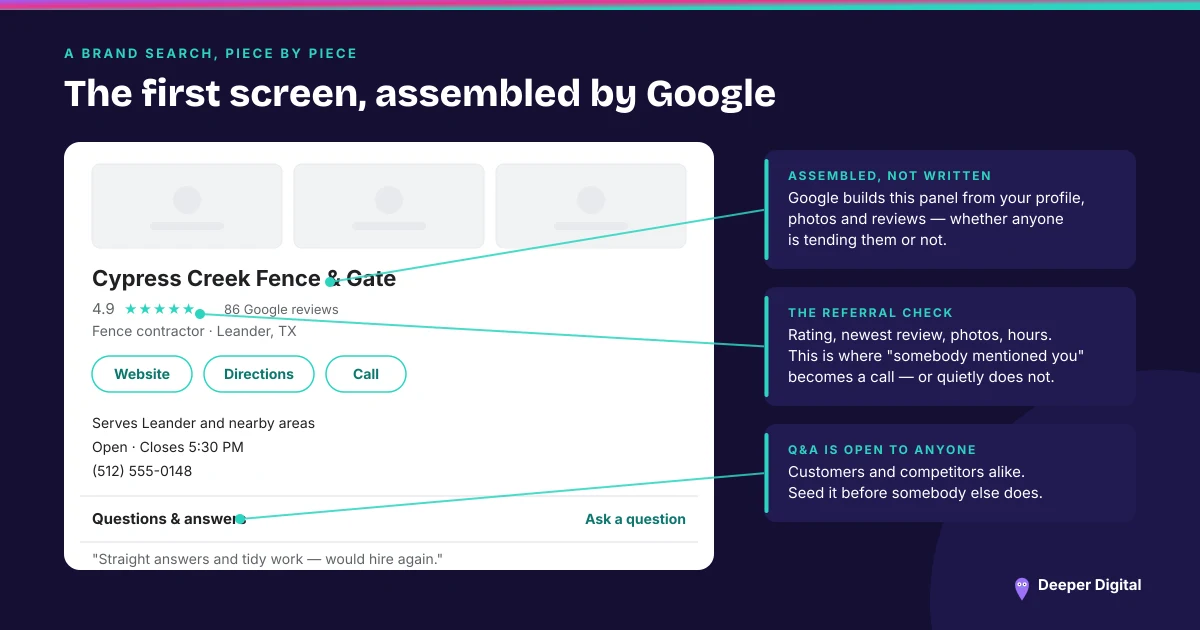
The profile has other link slots — the booking link is its own field, with its own job — but the website button is the one a comparison-shopping visitor presses. Everything they were promised by your profile — the category, the services, the photos — is now supposed to be confirmed by the page that loads. That is the whole test for choosing it.
The homepage wins by default, not by merit
A homepage is the safe choice when it actually describes what the profile describes. For a one-trade business with a clear homepage, done — stop reading, that is your answer. The mismatch appears when the profile is more specific than the homepage: a profile that surfaces for mobile IV therapy pointing at a wellness homepage that mentions IV drips in the third scroll. The visitor searched for a specific thing, and the homepage greets them with everything else first.
A service page answers faster
If your profile’s primary category names a specific service, the page behind the website button can name it too. The visitor who searched “ceramic coating” and pressed your website button is not researching your company’s story. Landing them on the ceramic coating page removes the one click where most of them leave. This is also the honest limit of the advice: which pages exist on your site is your call and your budget — the profile can only point at what is there.
Tagging tells the clicks apart
Once the link is chosen, label it. Campaign parameters on the URL — the same convention as tracking numbers, done without breaking your listings — let your analytics separate profile visitors from search, social and everything else. Without the label, profile clicks dissolve into general traffic and the profile gets credit for nothing. With it, website clicks become a line you can actually read — one of the few report numbers that mean anything.
Revisit it when the profile changes
Change your primary category, add a service, open a second offering that starts pulling searches — the website field does not update itself. A link chosen for last year’s profile can point at the wrong answer for this year’s searches. It takes a minute to check and most profiles have never checked once.
Where your pages live and what they say is your side of the website. The field itself is profile work — set, labeled, and revisited when the profile changes — and managing the profile is what we do, on every plan.
 NASP
NASP  Wild Foods Co.
  Noble Origins
  Cowboy Pools
  BT Biltong