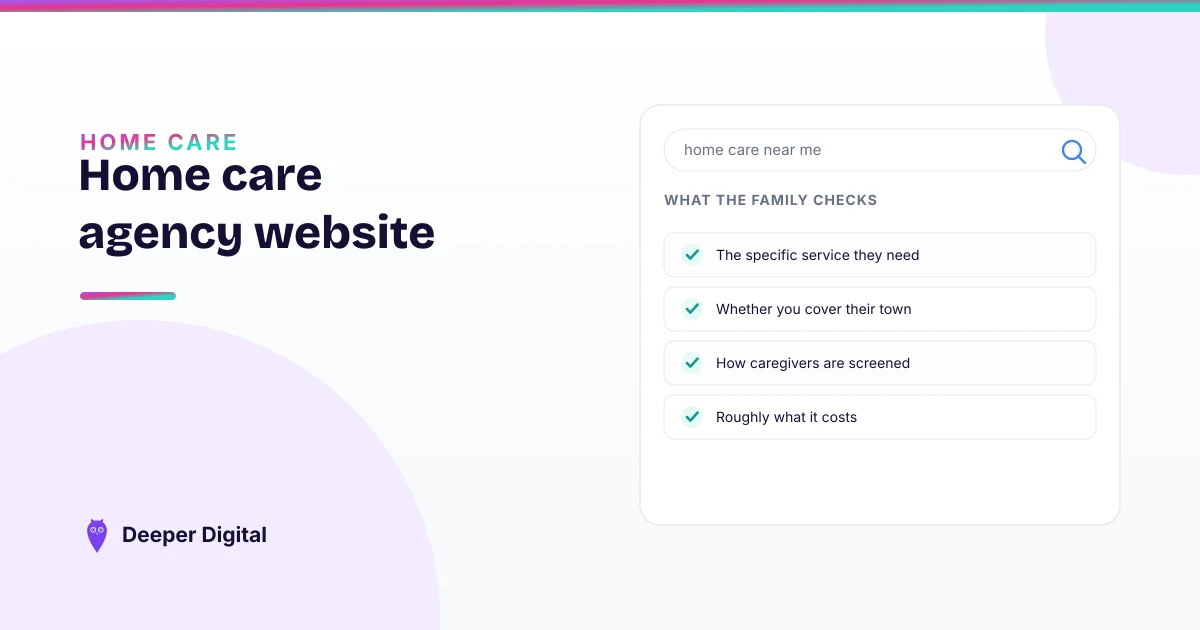
Families verify a home care agency somewhere other than the agency’s website. In Texas that place is the state: home care is licensed through Health and Human Services under the category Home and Community Support Services Agency, and HHS publishes a public long-term care provider search that anybody can use (checked 27 August 2026). The practical consequence is that your own surfaces need to agree with a record you do not control.
On the state’s record
The licensed entity name is the one on file, and it is often not the name on the van. Agencies operate under a trade name, register under a legal one, and then publish a third variation in a directory listing years ago. A family searching the provider database for the name they were given, and not finding it, does not conclude that the name is different. They move on.
Write down the exact licensed name, the license category, and the address on file. Everything else in this post is a comparison against that.
On the Google Business Profile
The profile name should be the name the business actually trades under, matching signage and the way the agency answers the phone. Credentials do not belong in the name field. They belong in the description and the services list, where they can be written in full sentences and updated without touching the name.
This is the same discipline as keeping name, address and phone consistent everywhere, applied to a detail most agencies never audit.
On the page a family lands on
The website is where a family checks whether the agency is what the referral said it was. The licensed name, the license category, and how the agency is insured belong somewhere findable — a footer, an about page, a page dedicated to it. Not in an image, and not in a PDF.
An agency serving more than one county has a second version of this problem, since the record and the service description have to agree across both. Two counties, one agency covers that setup.
In the reviews
Reviews carry credibility that a self-published credential cannot. A family reading five recent reviews from other families is doing the same verification job the state database does, in a form they trust more. That makes a working system for asking part of the same project as getting the licensing details right, rather than a separate one.
Where credentials do not belong
Not in the business name. Not as a substitute for what the agency actually does — a services list that reads “licensed, bonded, insured” and nothing else describes a status, not a service. And not as a comparison: publishing your own credentials is straightforward, and characterizing a competitor’s is a different activity with different risks.
Referral sources run the same checks, often faster, and they are checking against the profile and the site together.
Pull up the state provider search and look yourself up. Then compare that record against your website footer and your Google profile, line by line. If the three disagree, fix the two you control. Getting those surfaces consistent is part of onboarding — the home care page sets out the rest.
 NASP
NASP  Wild Foods Co.
  Noble Origins
  Cowboy Pools
  BT Biltong