Families choose a home care agency on Google, usually in one overwhelmed evening — a parent falls, and an adult daughter spends that evening choosing who’ll be in her mother’s house by Friday.
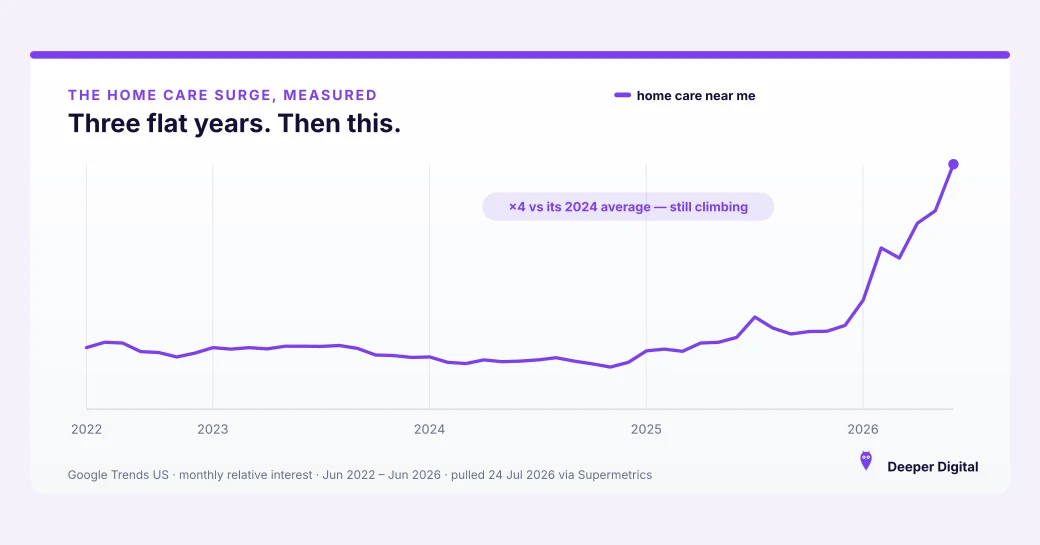
That evening is your entire marketing funnel. Search interest in “home care near me” sat flat for three years and now runs at about four times its 2024 average — demand is outgrowing supply, and all of those searches land on somebody’s profile.
What’s the best marketing for a home care agency?
Own the searches families actually run — starting with the profile setup families trust: “home care near me,” “in home care,” “private home care” — and increasingly “best home care,” which is rising fast. These searches rank on the signals in Google’s local-ranking guidance: a complete profile, proximity to the family’s search, and the prominence built by reviews and activity. Referral relationships still matter; the difference is that even referred families Google you before calling.
Why do reviews decide home care?
The stakes are a parent. Families don’t skim your rating — they read: Is this agency reliable?
Kind? What happened when something went wrong, and how did the owner respond?
A thoughtful reply to a difficult review persuades more than ten unanswered five-stars. Build a steady, respectful ask-system — families of long-time clients are usually glad to help other families choose.
What should you answer publicly before the first call?
The questions families type at 11pm, including the money ones — payment-related searches rise right alongside care searches:
- Cost and payment options — ranges and what insurance/programs may apply. Vagueness reads as expensive.
- Caregiver vetting — background checks, training, licensing (your state’s requirements, stated plainly). Recruiting those caregivers is the other funnel on the same profile.
- Backup coverage — “what if the caregiver is sick?” is the fear behind many first calls.
- Speed — how fast can care start; minimum hours.
Put these in your profile’s Q&A section and as FAQ content on your site — the same answers feed what ChatGPT and Gemini say when families ask AI for help, which they now do.
What does the profile itself need?
The fundamentals, done completely: “Home health care service” or the accurate primary category, every town you serve set honestly, staff photos that show real humans, and weekly signs of life. The 15-minute checklist catches most gaps in one sitting.
Families choose on reviews read at 10pm, so the review system that wins them is where this pillar is really won. One care client is a recurring engagement, not a one-off job, which makes the math more forgiving here than in most trades. Run it yourself, or have it run for you. Start with a free game plan.
 NASP
NASP  Wild Foods Co.
  Noble Origins
  Cowboy Pools
  BT Biltong