Changing an address, a business name, or your opening status sends the profile back through Google’s review. Google states that edits to a verified profile are checked against its guidelines, usually taking up to 10 minutes but sometimes up to 30 days — and that some changes are not edits at all, but a new business.
Knowing which of those you are doing, before you touch anything, is most of the job.
First, decide whether it is still the same business
This is the fork, and Google draws it sharply. Its reopening guidance says that if a business was marked permanently closed as part of a location or name change, do not reopen it — add a new business instead, verify that new profile, and contact Google if you want the reviews moved across.
Read that last part again. Reviews do not follow a new profile on their own. Years of them can sit on a record that now describes a business that no longer exists under that name.
So: a shop that moved two blocks and kept its name is an edit. A partnership that dissolved and reopened under a different name at a different address is a new profile with a review problem attached. Most real situations sit between those, and the deciding question is the one Google uses everywhere else — is this how the business is consistently represented and recognized in the real world, on its signage, its stationery and its branding?
Then change one thing at a time
Google reviews edits for accuracy, and it says it might not approve a change when it cannot confirm the new information.
Changing the name, the address and the primary category in one sitting gives the review three unfamiliar things at once and gives you no way to tell which one it disliked. Sequence them. Get the website and the signage saying the new thing first, so there is something to confirm against, then move the profile. (Why the same name, address and phone in three places is not a formality.)
Expect a review, and check its status
Every edit resolves to accepted, pending, or not approved, and there is a view for checking which. Pending is the normal state for a while — Google’s own range runs from ten minutes to thirty days, which is not so much a window as a shrug.
Not approved is the one to act on. Google notes that rejected business information edits may be appealable. Before appealing, it is usually faster to make the outside world agree: update the site, the listings you control, and anything that still carries the old details. (Which listings you actually own, and which are rented.)
Pausing is a different button from closing
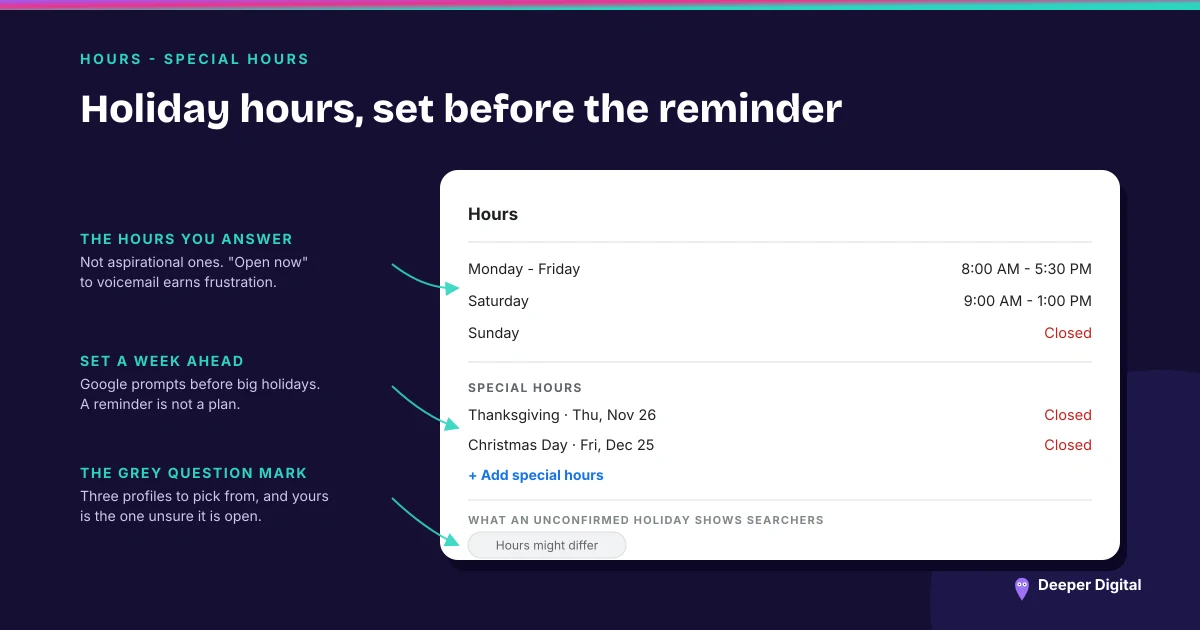
Google splits this by duration. Closed for more than seven days, closed for the off-season, or closed indefinitely: mark the profile temporarily closed. Closed for seven days or less: use special hours instead. (How special and holiday hours work.)
It also notes that if it receives an update that a location is temporarily closed, you may get an email notification — which is a reminder that closure status is one of the fields the public can suggest a change to. (Who else can edit your profile.)
And temporary closure has a visible cost
Google states it directly: for broad queries, temporarily-closed businesses can rank after open businesses, and the effect depends on factors like business category, query type, and how many matching businesses are temporarily closed.
That is Google naming a consequence rather than a rumor, and it is the honest argument for using special hours where special hours apply. A two-week holiday shutdown marked as temporarily closed is a correctness decision with a search cost attached — worth taking knowingly, not by accident.
If you are a service-area business, the move is different
A business that travels to customers is changing a service area, not a storefront the public visits, and the two are governed differently. A detailer moving from a suburb into Austin proper is redrawing where the work happens, and the profile has to reflect that rather than a new pin on a map. (Storefront and service-area profiles, and the rules that differ.) (What a big-metro market changes.)
Last, walk everything that is not Google
The website footer. The invoices. The Apple place card. The listings. The voicemail greeting that still says the old address.
An address change is not finished when Google accepts it. It is finished when nothing anywhere still says the old one, which is the same standard that keeps a profile out of trouble in the first place. (What actually triggers a suspension, and what to do about one.)
Sequence the change, expect a wait, and use special hours for anything under a week. If the move is a real one and you would rather not manage the paper trail across every listing yourself, that is the citation work on the plans.
 NASP
NASP  Wild Foods Co.
  Noble Origins
  Cowboy Pools
  BT Biltong