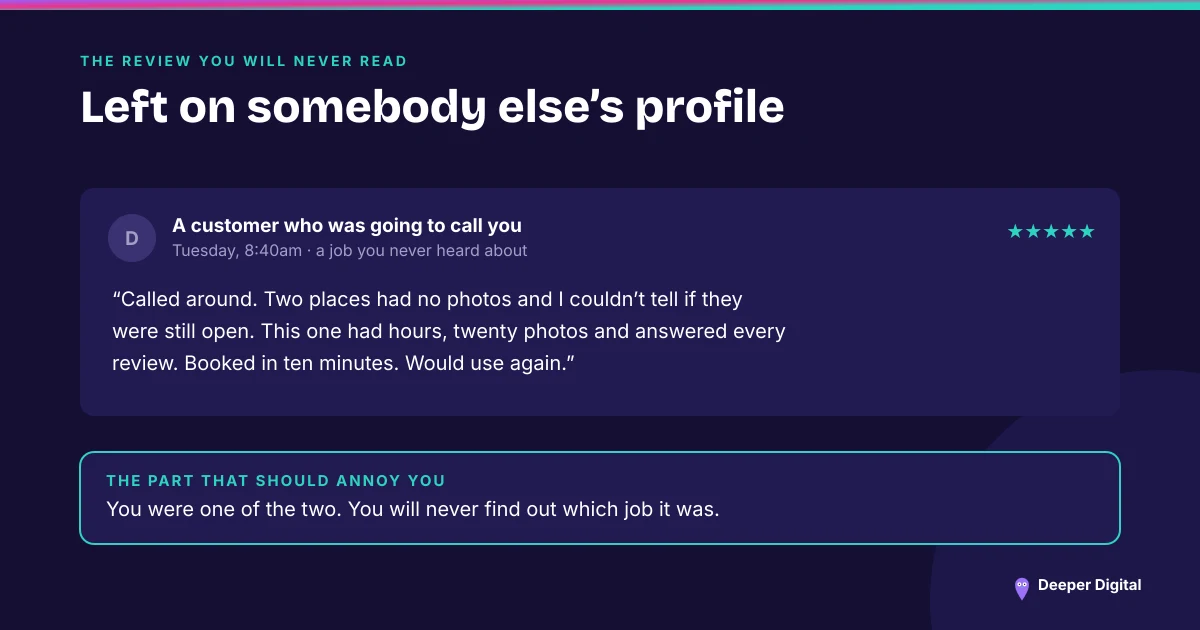
Google is still where local calls start, and nothing here changes that. What changed is where reviews written elsewhere end up being read: several platforms now license their content to other companies, so a review left on a site you ignore can surface inside a product you have never opened.
That is the reason to look at the other platforms at all. Not because they are competing with Google for your customers — because they are feeding things that answer questions about you.
Yelp, and what it is doing with its content
Yelp’s business now includes licensing its reviews, ratings, photos and business details onward. In its own announcement of 10 August 2026, it described an existing content integration with OpenAI’s ChatGPT, added restaurant reservations and waitlists to that integration, and named Apple Maps, Amazon’s Alexa+, Microsoft Bing, DuckDuckGo and Yahoo! among the platforms carrying Yelp-powered recommendations.
Read that as what it is: a company describing its own distribution, on its own blog, on a date that will eventually be old. The claim worth taking from it is structural rather than promotional — review content is now an input to other systems, not just a page on the site that collected it. (How assistants assemble a local answer, and what you can actually check.)
What it is not is a reason to start a review campaign on Yelp. Nothing in that announcement says a Yelp review outranks a Google one for a customer standing in your market with a phone.
Facebook, which is mostly an address problem
Most local businesses have a Facebook page with recommendations on it, and most of those pages have hours or an address that stopped being true at some point.
The reviews there are rarely the issue. The business details are, because they are one of the many places a mismatched address gets recorded. (Why one wrong digit propagates further than it should.)
Trade directories, which are worth exactly what your buyers use
In some trades a specific directory is genuinely where buyers look — a care-locator, an industry association listing, a manufacturer’s installer finder. In most trades the directory in question is a listing farm that emails you monthly.
The test is not the directory’s traffic. It is whether a customer of yours has ever mentioned finding you there. If none has, it is a citation, and citations are judged on whether you own them rather than on the reviews they hold. (Owned listings versus rented ones.)
Your own site, which nobody licenses
Testimonials on your own pages are not reviews and should never be presented as if they were. They are marketing copy, they carry no third-party verification, and a visitor knows it.
They still earn their place, for a different job: a named, specific quote next to the service it refers to does work that a five-star average cannot. Keep them, label them honestly, and stop counting them.
What we manage, and what we do not
Our review work is Google. The profile, the ask, the replies within a business day. We do not manage Yelp, we do not run campaigns on it, and we are not going to tell you that a package covering six platforms is six times better than one covering the platform your customers use.
If a second platform matters in your trade, the honest advice is usually: claim the listing, make the details correct, answer anything that arrives, and put the effort into Google. (Where the reply work goes, and the format that holds up.)
The ten-second check
Search your business name and city. Read what comes back before you decide any of this needs a strategy. Most owners find one abandoned profile with an old address and nothing else worth doing.
Fixing that is a records job. It takes an afternoon and it does not recur — unlike the Google review flow, which is ongoing work on every plan.
 NASP
NASP  Wild Foods Co.
  Noble Origins
  Cowboy Pools
  BT Biltong