A virtual consult changes how a patient meets you. It does not change where your clinic is, where it serves patients, or what its Business Profile should say about either. Clinics get this wrong in both directions — some stretch their coverage to every city a video call reaches, others hide the local service they actually deliver behind a telehealth-first website.
Settle the address question first
Google’s own setup rules are about premises, and they are short. If you do not serve customers at your business location, do not add your business address to the profile. If the location has no permanent on-site signage, list the business as a service-area business rather than a storefront.
Neither test mentions how appointments are conducted. Both are about the building. A clinic that sees patients at a suite on Burnet Road is a storefront whether or not half its consults happen on a screen, and a mobile provider is a service-area business whether or not the intake call is a video call. (The full classification, and what each one changes downstream.)
The first error: coverage that is really call reach
The service area is the field that tempts. Adding twenty Texas cities takes four minutes and feels like growth.
What makes it a bad trade is that the field describes where the business serves customers. Google’s verification process for service-area businesses asks for footage of the address it operates from, landmarks around it, and proof of the equipment or documents the business works with. That is a test about a physical operation, not a coverage map, and a video consult does not satisfy any part of it.
There is a practical cost too. A service area drawn far wider than the business actually travels makes every other signal on the profile harder to read, and it invites the same scrutiny that mobile providers already attract. (Mobile IV clinics run into that scrutiny first, and the write-up applies to any mobile provider.)
The second error: the local half goes unsaid
The opposite failure is quieter and more common in clinics that lead with telehealth. The website opens on booking a video consult, the profile description talks about virtual care, and nowhere does the clinic plainly state the treatments it performs in person, at an address, in a named city.
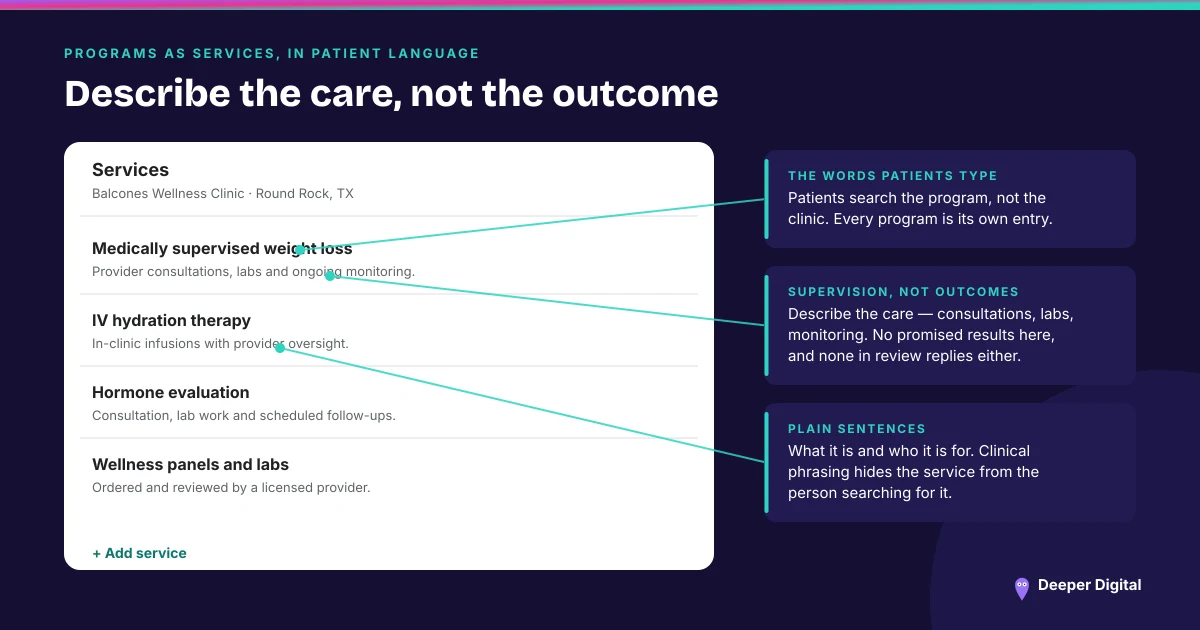
Patients searching for a provider near them are not searching for a platform. If the in-person service exists, it needs saying in the words patients use for it — on the profile description, on the service list, in the same terms they would type. A clinic that offers both and describes only one is choosing which half gets found.
Where the consult itself goes
List it as a service. Google’s services editor is scoped to work a business performs, and Google directs businesses selling services there rather than to the products editor. A virtual consult is work performed, so it belongs on the service list, with a description, beside the in-person appointments. (Which editor your profile has, and what belongs in each.)
Write it the way a patient would say it — “video consultation” rather than an internal appointment code — and keep the claims in that description to what the visit is: who you speak with, how long it runs, what happens after.
The consult format is a clinical and licensing decision, and it stays with your providers. What sits alongside it is the profile that has to describe the clinic accurately: address, service area, services and reviews, kept current. That is the wellness clinic work we run.
 NASP
NASP  Wild Foods Co.
  Noble Origins
  Cowboy Pools
  BT Biltong