Before-and-after photos can be published on a Google Business Profile, but two separate conditions have to hold: written patient authorization that names this specific surface, and images that comply with Google’s photo guidelines. Meeting one does not cover the other. A fully consented photo can still be removed by Google, and a photo Google accepts can still be a consent problem.
Most practices handle the second condition and assume the first.
Consent has to name the surface
An authorization form permitting use in a website gallery does not permit use on a Google Business Profile, a review reply, or a social account. The surfaces differ in reach, in who can download the image, and in how hard removal is later.
The version that holds up is specific: the treatment, the date, each named surface, and a plain statement that the patient may withdraw permission at any time. When a withdrawal comes in, the image comes down everywhere it was published — not only where the patient happened to notice it.
Keep the signed authorizations and the original files in your own records. Platforms are not a filing system.
Google’s rules are a second, separate gate
Google’s published photo guidelines ask for images that are genuine, taken at or of the business, and free of watermarks, added text and heavy manipulation. Those guidelines get revised, so read the current version before building a set rather than trusting a summary — including this one.
The part worth planning around: clinical images of a treated area sit near several content-policy lines, removals are usually automated, and there is no dependable appeal. Build the set so that losing it costs you a morning, not a year of documentation.
What the photos have to do to be worth anything
A before-and-after that changes lighting, distance and angle between the two frames documents a camera, not a treatment. If a set is going to be published at all, hold the variables steady: same lighting, same distance, same angle, neutral background, no filters.
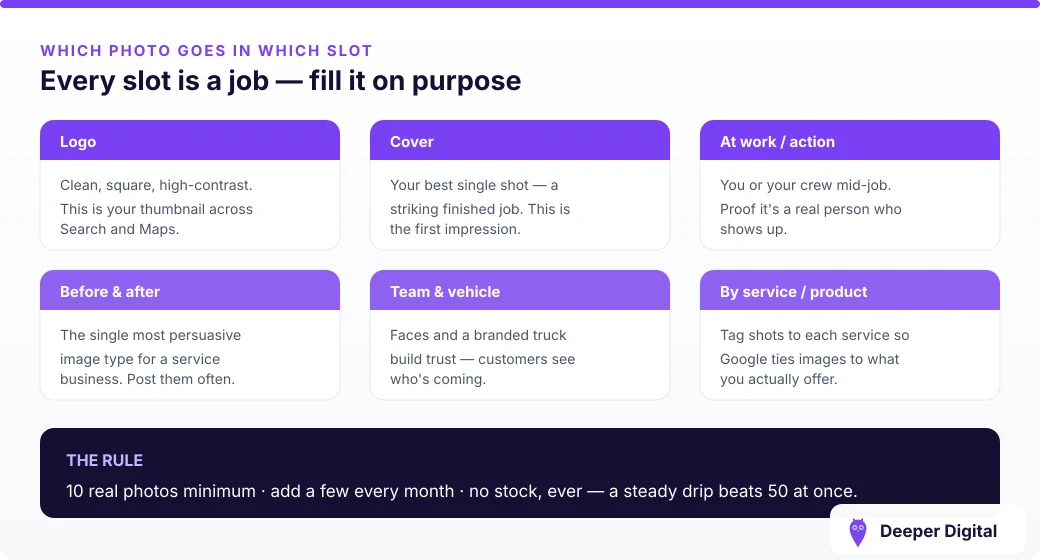
And note what carries the comparison for most people choosing between profiles — the treatment room, the equipment, the provider’s face, the front door they will walk through. Those are unrestricted, require no authorization, and are the photos a profile is usually missing. (Which photo belongs in which profile slot.)
Captions are claims
Any caption describing what a treatment achieved is a medical claim, and it belongs in front of a licensed provider before it goes anywhere public. “Two sessions, four weeks apart” is a record. Anything asserting a result is not, and outcome language in a caption carries the same weight as outcome language on a services page.
The short version
Consent that names the surface, images that meet the current guidelines, steady technique, and captions a provider has signed off. The profile photos that do the most work are often the ones needing no authorization at all.
We keep the profile itself accurate — categories, services, hours, photo slots filled correctly, and reviews answered within one business day. See local SEO for med spas and aesthetics.
 NASP
NASP  Wild Foods Co.
  Noble Origins
  Cowboy Pools
  BT Biltong