Four things win coating jobs from a Google Business Profile: the most specific category, every package listed as its own service, a gallery that proves the craft, and reviews that name the car.
A coating buyer isn’t impulse-shopping — they’re about to spend $1,500–$5,000 and they research you like they’d research a contractor. The searches are fewer than in other trades, but each one carries a four-figure job, so a profile built right pays for itself on a single booking.
What’s the best category for a coating shop?
Usually “Car detailing service” as primary — it’s the most specific real category that covers coating work in most regions — but open the category box and search “coating” and “paint protection” first; Google adds categories over time, and the most specific real match always wins. Add honest secondaries: window tinting service if you tint, and your detailing lines. The primary category decides which searches you’re even in — Google’s guidance is the most specific category for your main business. (Get the category right first.)
Which services should a coating shop list?
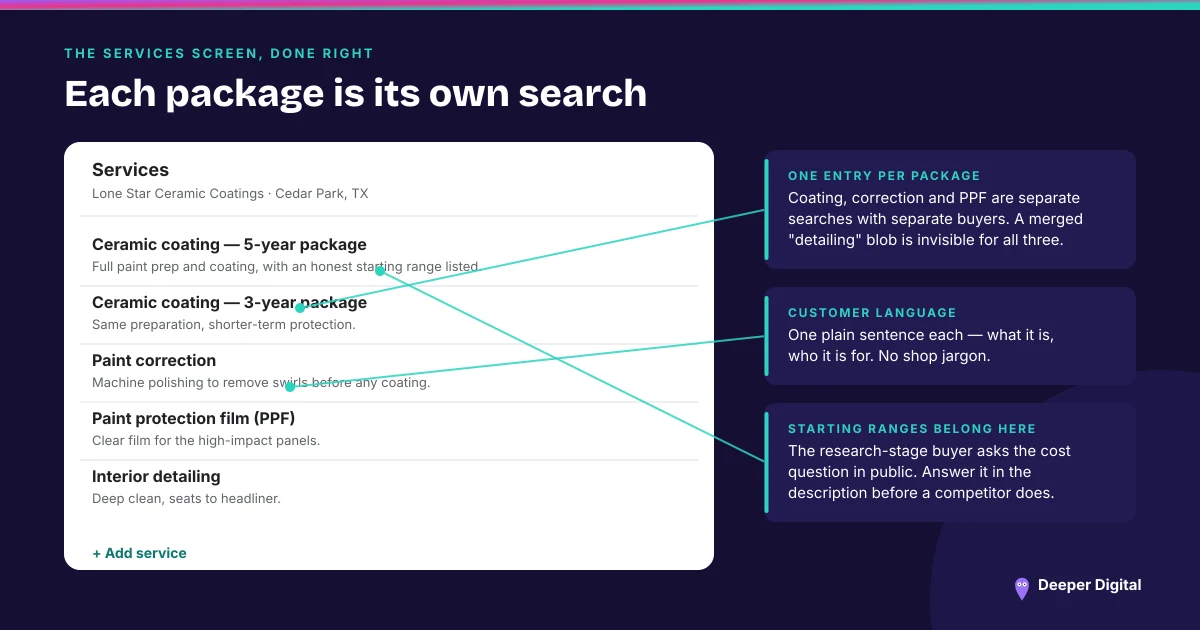
Each package and each craft as its own entry: ceramic coating (by package/years if you tier them), paint correction, PPF installation, interior detailing, maintenance washes. Coating, correction, and PPF are separate searches with separate buyers — a merged “detailing” blob makes you invisible for the exact high-ticket queries. One customer-language sentence each: what it protects, roughly how long it lasts. (The Services section, properly.)
Should you publish prices?
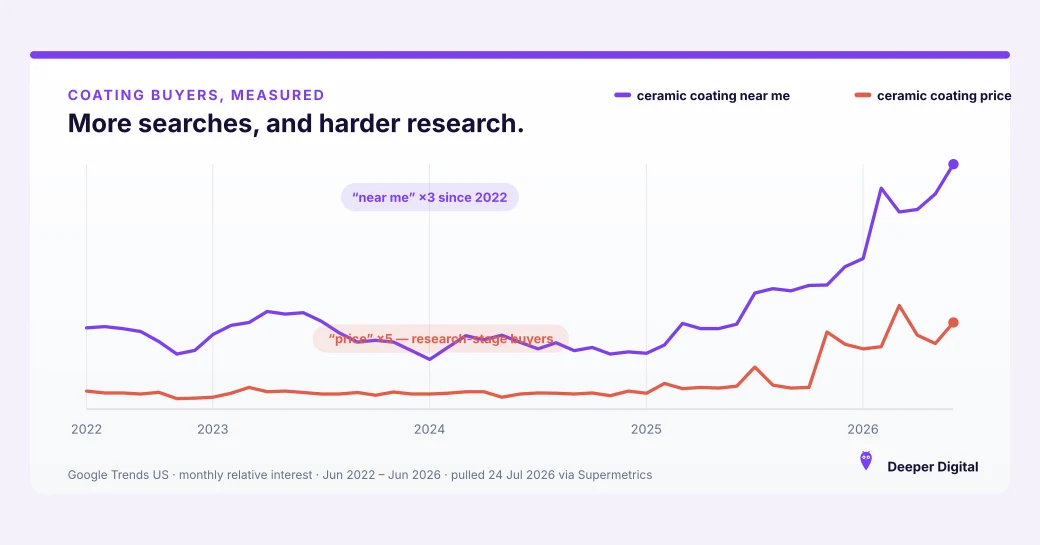
Yes — honest starting ranges. “Ceramic coating price” is one of the fastest-rising searches in the category, which means the research-stage buyer is asking in public.
The shop that answers (“coatings from $1,200, most trucks $1,800–2,500 with correction”) wins that buyer’s trust before competitors even load. Put ranges in your service descriptions and answer the cost question in your Q&A section. Hiding prices doesn’t protect your margin; it donates the customer to whoever answered.
How do photos sell coating work?
They’re your closer — coating is the most visual trade there is. Real gloss shots, 50/50 correction panels, PPF edges, workshop shots that show a clean bay.
Upload steadily (a few each week beats a giant dump), and rename files honestly before upload (“ceramic-coating-f150-austin.jpg”) for a small free relevance bump. The buyer flips through your gallery the way they’d walk your shop — make it prove the craft. (Which photo goes in which slot.)
How do reviews close a $3,000 job?
The gallery gets you shortlisted; reviews get you booked. Buyers comparing two shops read for reassurance: prep quality, how the coating held up, whether the shop stood behind the work.
Ask at the reveal — the moment they see the finished car — and nudge them to name the vehicle and service (“ceramic coated my Tacoma”), which pulls you into truck and model searches. Reply to every one.
A steady flow of these beats a wall of stale five-stars. (The ask-system · reply templates.)
Ceramic coating profile quick checklist
A coating profile that wins high-ticket jobs has six marks — specific category, split services, public price ranges, a proving gallery, reviews that name the car, weekly activity:
- Primary category = most specific real match (usually Car detailing service)
- Coating / correction / PPF / detailing each listed separately
- Honest starting price ranges, in services and Q&A
- Fresh gloss and 50/50 shots weekly, honestly named files
- Reviews naming vehicle + service, every one replied to
- One install post a week (posts signal a live shop)
The honest shortcut
All free, all doable between installs — the full ceramic coating marketing playbook has the strategy around it. The weekly upkeep is what we run. See done-for-you local SEO for coating and detailing shops, or grab a free game plan — we’ll pull the three profiles a coating buyer sees before yours.
 NASP
NASP  Wild Foods Co.
  Noble Origins
  Cowboy Pools
  BT Biltong