A truly complete Google Business Profile comes down to 12 specific fields — category, services, areas, hours, photos, reviews, and recent activity — and this checklist scores yours on all of them in 15 minutes.
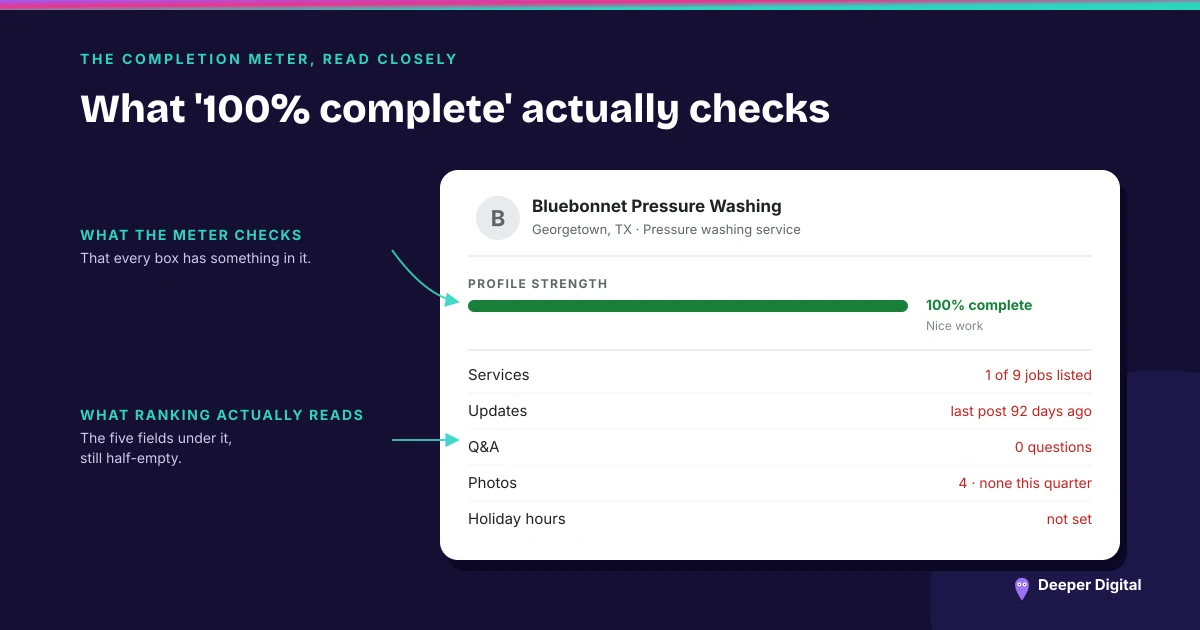
Google says your profile is “100% complete.” It’s lying to you — that meter fills up long before the fields that decide your ranking do.
We run this exact checklist on every profile we audit, including our own. Most businesses fail at least four items. Grab a coffee, open business.google.com, and score yourself.
What makes a Google Business Profile “complete”?
A complete profile has the right primary category, every service listed with descriptions, accurate service areas, current hours, at least 10 real photos, and activity in the last 30 days. Google’s own completion meter checks none of this properly — it just wants something in each box.
Here’s the actual list.
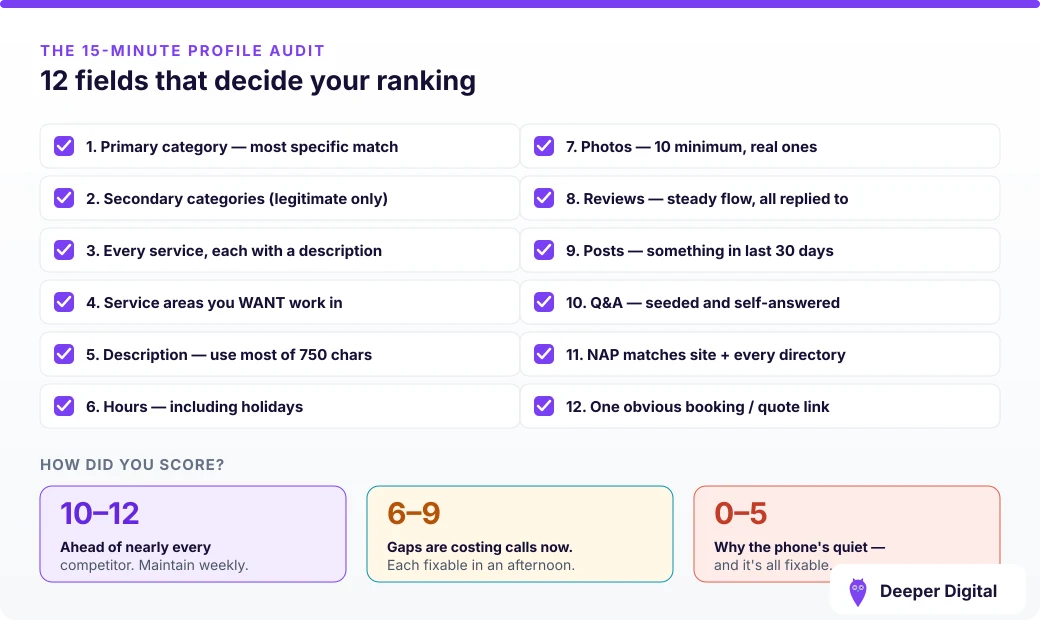
The 15-minute checklist
1. Primary category — the single biggest lever. Is it the most specific category that matches what you want to be found for? “Pressure washing service” beats “Cleaning service” every time — Google’s own guidance says to pick the most specific category that represents your main business. This one field outweighs almost everything else — here’s how to get it right.
2. Secondary categories. Add every category you legitimately serve. Legitimately. Stuffing categories you don’t do breaks Google’s guidelines for representing your business and gets profiles suspended.
3. Services — every one, with descriptions. Open the Services section. Is every service you sell in there, each with a sentence of description? Blank services are the most common gap we find, and they’re free rankings left on the table — here’s how to fill the Services section properly.
4. Service areas. Are the cities you actually want work in listed? Not just where you’ve worked — where you want to work.
5. Business description. 750 characters available. Use most of them. Say what you do, where, and for whom — plainly. No keyword stuffing; Google ignores it and customers hate it — here are description examples that actually work.
6. Hours — including holidays. Wrong hours are a trust killer. A “Closed” label at 2pm on a Tuesday sends the call to your competitor.
7. Photos — 10 minimum, real ones. Real jobs, real equipment, your actual crew. Stock photos are worse than no photos. Add a couple every month, not fifty at once — and here’s which photo belongs in which slot.
8. Reviews — flow, not total. Are you getting reviews steadily, and replying to every single one? A dead review stream reads as a dead business. The system for getting them is simple — here’s the whole thing — and here’s how to reply without sounding like a robot.
9. Posts — anything in the last 30 days? An empty Updates tab tells Google and customers nobody’s home. Do posts matter? We measured.
10. Q&A section. Anyone can ask a question on your profile — including competitors. Seed it with the five questions customers actually ask, and answer them yourself — here’s how to own your Q&A section.
11. Phone and website match everywhere. The name, address, and phone on your profile must match your website and every directory you’re listed in. Mismatches quietly erode trust — here’s how to fix NAP consistency.
12. Booking / quote link. Is there one obvious way to take the next step? Ranking first and then making people hunt for a way to contact you is an expensive way to be popular.
How did you score?
Most profiles we audit land at 6–9 — solid bones, with gaps quietly sending calls to competitors. Here’s what your number means:
- 10–12: You’re ahead of nearly every competitor we’ve audited. Keep it maintained weekly.
- 6–9: The gaps are costing you calls right now. Each one is fixable in an afternoon.
- 0–5: Good news, honestly — this is why the phone’s quiet, and it’s all fixable.
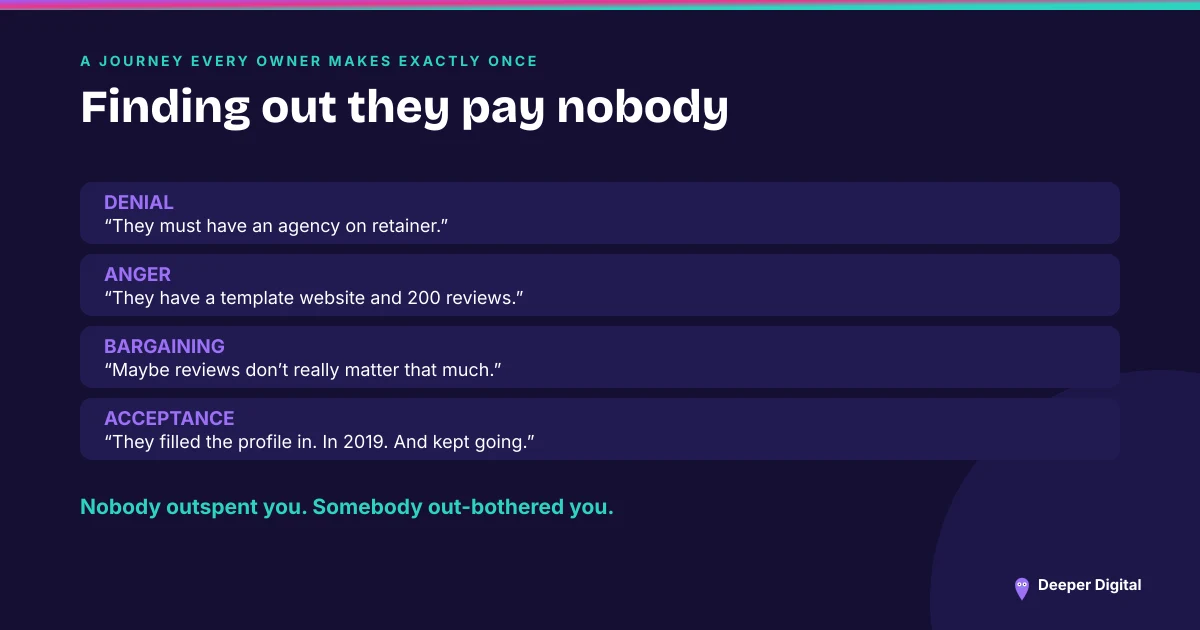
Do I need to pay someone to fix this?
No. Every item above is free and you can do it yourself, which is why we published the list instead of putting it behind an email form — same for the bigger picture of how Maps ranking actually works.
The checklist isn’t the hard part. Most owners run it once in January and never open the dashboard again — and profiles decay quietly. Weekly is the hard part, and that’s what we sell: here’s what ships. Spot-by-spot game plan of your own profile first — free, no card, here.
 NASP
NASP  Wild Foods Co.
  Noble Origins
  Cowboy Pools
  BT Biltong