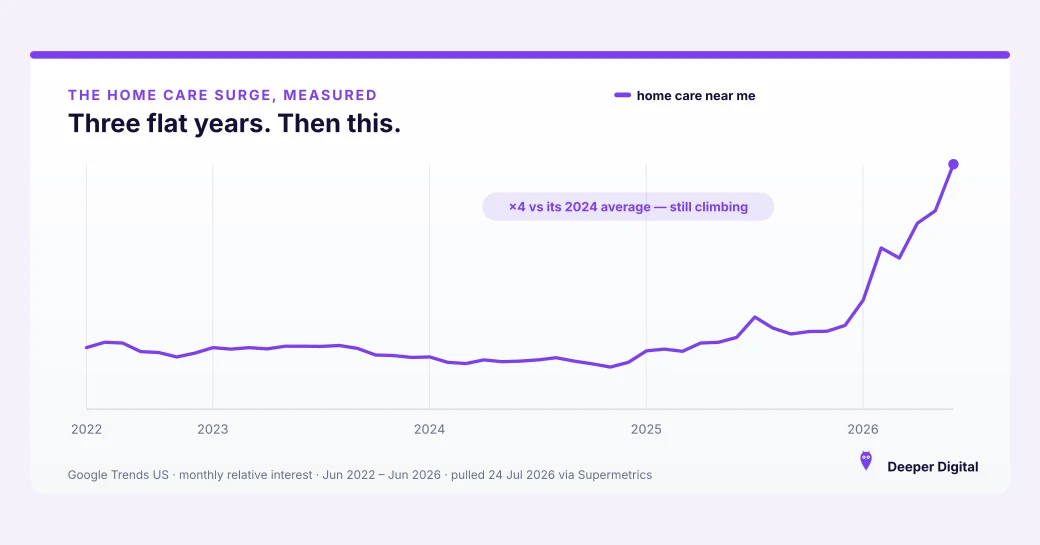
The call that comes at eleven at night is rarely about home care in general. It is about tonight, and tomorrow night, and the fact that nobody in the family has slept properly in three weeks.
Families in that position do not search for an agency. They search for the hours they need covered — overnight care for elderly parent, 24 hour care at home, someone to stay overnight with my mother. The service they want is defined by a clock, and most agency profiles describe themselves by category instead.
Three arrangements, and families do not know which one they need
The words get used interchangeably in conversation and mean different things on an invoice.
Overnight care covers the night hours. One caregiver, through the night.
24-hour care covers the whole day, usually with caregivers in shifts so that someone is awake at all times.
Live-in care is a third arrangement again, with different scheduling and rest requirements attached to it.
A family calling for the first time often asks for one and describes another. That is not their failure — it is a distinction nobody encounters until the week they need it. Describe your own arrangements in your own words, name what each one includes, and let the family recognize theirs. Do not explain what the terms mean in general across the industry; explain what they mean at your agency, because that is the only version you can stand behind.
The question underneath all of it: is the caregiver awake
This is the first real question, it is asked hesitantly, and an agency that answers it before being asked separates itself immediately.
Awake overnight, or sleeping with the expectation of being woken. Those are different jobs, priced differently, and the family is trying to work out whether their father will be found on the floor at four in the morning. Say which one you provide, plainly, near the top.
Where these belong on the profile
Not in a paragraph. As named service entries, each with a plain one-sentence description — overnight care, 24-hour care, live-in care listed separately, because they are separately searched.
That is what makes a profile eligible for the specific search rather than the general one, and the services list is a ranking surface that most profiles leave half empty. Filling it has a second effect now, too: the job types a customer can pick when reviewing a service business are drawn partly from the merchant’s own service list, so naming the work precisely changes how the review comes back.
The hours field is not the care schedule
Here is the trap specific to this service.
An agency offering 24-hour care looks at the hours field and reasons that it should say 24 hours. Sometimes that is right. Often it is not, and it produces a profile that says Open now at 2am while the phone rings out.
The hours field describes when the business can be reached. If your phone is genuinely answered by a person around the clock, reflect that — for this service it is a real competitive advantage and it should be visible. If your office closes at five and the on-call phone is a different number, say what is true, and let the services and description carry the coverage message. A family that calls an “open” business at midnight and gets voicemail does not conclude that the hours were misconfigured; they call the next agency. The hours field has more consequences than its size suggests, and this is the one that costs the most.
Four things the page has to answer
Overnight inquiries convert or die on specifics. In order of how often they come up:
- Is the caregiver awake all night, or sleeping and available?
- Is it the same caregiver each night, or a rotation — continuity matters more at night than at any other hour
- What is the minimum, in nights or hours, and how are overnight rates structured relative to daytime
- How soon can cover start — describe your process honestly, without committing to a timeframe you cannot staff
On the fourth: never promise availability you do not have. A family told “tonight” who is then told “Thursday” does not come back, and word travels between families faster than it does between businesses.
Do not promise the outcome, describe the arrangement
The temptation in this vertical is to write about peace of mind and rest and relief. Some of that is fine, and a little goes a long way.
What actually books the job is the concrete part: who arrives, whether they stay awake, how the shift changes, what happens if the caregiver is unwell, what the family is charged. Those answers respect the reader’s situation more than an adjective does.
The same principle governs the first help most families accept at all, which is rarely full coverage and is usually something shorter.
List overnight, 24-hour and live-in care as separate named services, then answer the awake question in the first line of each. The services list and the profile behind it are part of every plan we run.
 NASP
NASP  Wild Foods Co.
  Noble Origins
  Cowboy Pools
  BT Biltong